
The liquid staking protocol ether.fi (ETHFI) will completely sever its remaining structural ties with the EigenLayer restaking protocol this quarter. According to the project’s documentation, as of August, less than 1% of the protocol’s assets remained in restaking, and the accounting data for withdrawing from EigenPod is scheduled to be deleted by the end of the year.
What has changed. When ether.fi launched in 2024, all deposits were automatically sent to restaking on EigenLayer. In August 2026, the company removed restaking from weETH—the protocol’s primary token, widely used in DeFi as collateral. Now, weETH functions as a standard liquid staking token. Users who still wish to earn yield from restaking must separately opt for weETHs tokens built on the competing platform Symbiotic.
ether.fi CEO Mike Silagadze explained the decision in terms of risk versus reward: according to him, there are no longer significant opportunities for earning in restaking, and stakers perceived it as an additional risk, making the exit a logical step.
The promised “double yield” never materialized. The idea behind restaking was that locked ETH could serve a second purpose: EigenLayer would “rent out” its security to third-party services—such as oracles, data availability layers, and others—and those services would pay for the protection. At its peak, EigenLayer held $19.7 billion. However, the services buying security never paid enough to cover both the base staking yield and the premium above it.
The numbers clearly illustrate the scale of the problem. According to DefiLlama data as of September 8, the restaking sector with a TVL of $10.02 billion generated only about $100,000 in fees over the week. By comparison, liquid staking with a TVL of $51.87 billion brought in $27.35 million during the same period. Per dollar, regular staking earns roughly 53 times more.
What finished off the sector. Two events finally made restaking unattractive. First, the point programs that effectively subsidized deposits ended in 2025. Second, in April 2025, EigenLayer activated slashing—a penalty mechanism where operators lose part of their staked ETH for violations. The risk went from theoretical to real, and no additional yield emerged to compensate for it.
If you exclude ether.fi, the rest of the sector looks quite modest. The five largest remaining liquid restaking protocols—Renzo, Kelp, Swell, Puffer Finance, and Bedrock—collectively earned $953,350 in gross profit in the second quarter of 2026, compared to $2.18 million three quarters earlier. Puffer, which once raised $23 million in investment, earned just $21,590 for the quarter, while Swell earned $22,370. Moreover, reports show that these companies’ profits came from regular staking fees rather than restaking itself.
The Kelp hack dealt another blow. In April 2026, an attacker targeted Kelp’s cross-chain bridge and, within 46 minutes, minted 116,500 rsETH worth around $293 million without any collateral. These tokens were deposited into Aave as collateral, allowing the attacker to borrow real ETH against them. In the following days, about $6 billion was withdrawn from Aave, and the potential unrecoverable debt was estimated at $123–230 million. The EigenLayer mechanism itself wasn’t affected—the vulnerability lay precisely in the bridge. But the incident showed that holders of liquid restaking tokens take on additional technical risks without receiving extra yield in return.
A new strategy for ether.fi. Instead of restaking, the company is betting on a crypto neobank model: ether.fi now has a card that lets users spend cryptocurrency as collateral without selling it, a lending market on the Optimism network, and a set of vaults. In August, the protocol added tokenized stocks, metals, and fiat payment channels. The card’s share of monthly revenue rose from 17% in January to 46% in July.
According to Silagadze, revenues from the neobank fully offset losses from restaking and the fall in ETH price: staking and restaking revenue declined by 70%, but overall annual revenue growth, he estimates, will increase by about 38%. DefiLlama data paints a different picture, though: ether.fi’s gross profit fell by 47%—from $18.71 million in the third quarter of 2025 to $9.99 million in the second quarter of 2026. Interestingly, in the second quarter, restaking on EigenLayer ($2.87 million) was still ether.fi’s second most profitable segment after the card ($3.14 million).
EigenLayer is changing course too. EigenLayer itself has stopped promoting restaking as its main product. After rebranding to EigenCloud, the project is focusing on verifiable computation, and restaking serves merely as a basic layer of security. The amount of assets in the protocol has shrunk to $5.1 billion from $22.06 billion in August 2025.
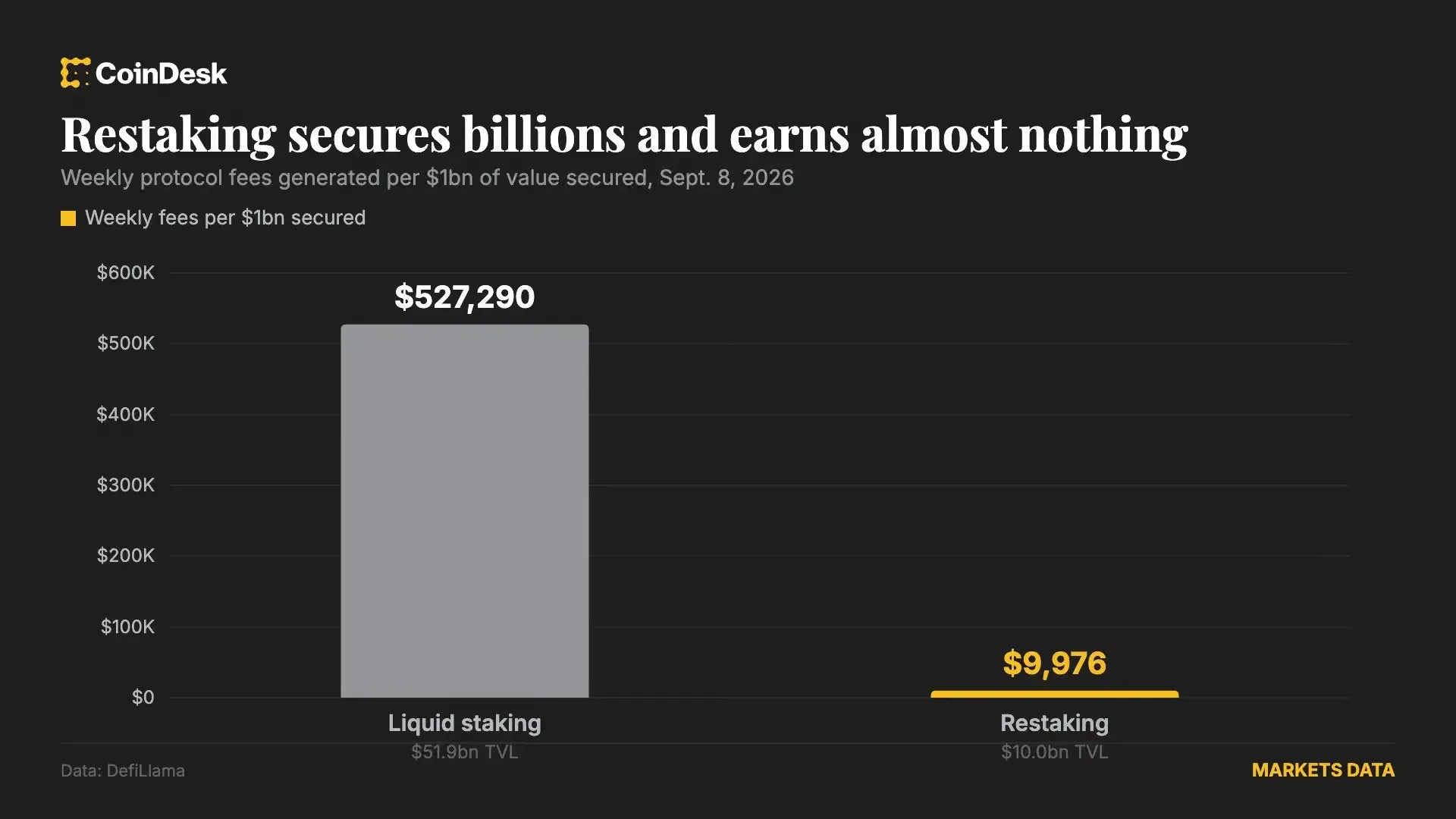
The restaking sector ($10 billion TVL) generated $100K in fees over the week