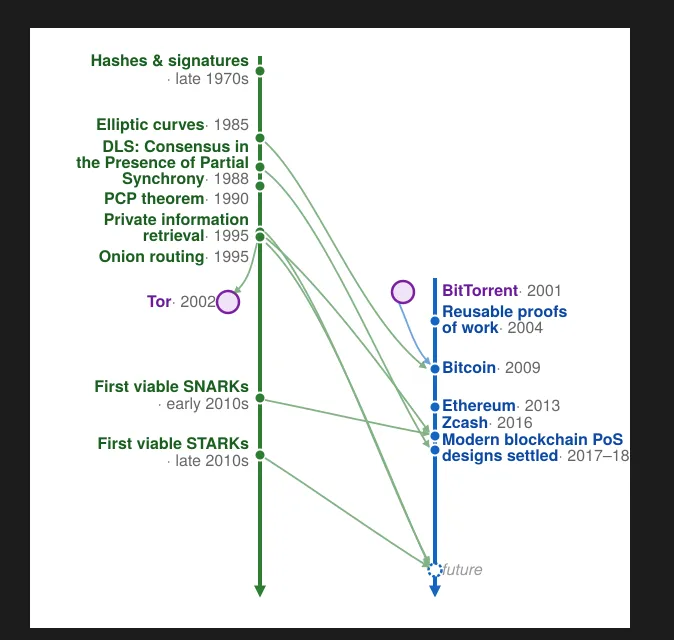
Buterin posted that by 2030, Ethereum will become a qualitatively different system. Block verification will shift from full recalculation to verification via SNARKs; consensus will achieve fast finality; multiple participants will build blocks simultaneously; and privacy will be ensured by ZK proofs at all levels.
The economics for developers are changing: sequential computations will remain expensive, while everything that can be parallelized and cryptographically verified will become cheaper. Decentralization, once seen as a cost of security, could become an advantage in terms of performance.
Hegota in 2027 will be the last “conventional” fork recognizable to someone from 2015. Beyond that, we’ll see recursive STARKs, formal verification, and quantum resistance.