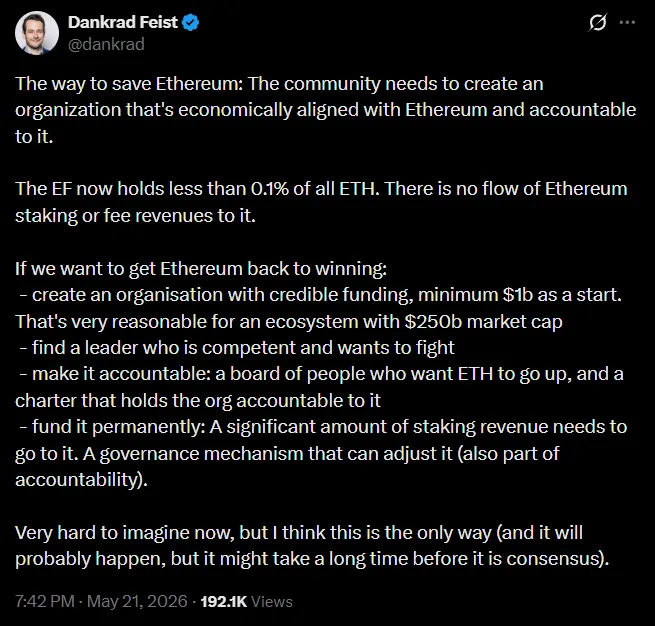
Dankrad Faist, a former researcher at the Ethereum Foundation, called on the community to establish a new organization that would be economically incentivized to grow ETH. According to him, the EF currently holds less than 0.1% of all ETH and does not generate revenue from staking or fees, which deprives it of any motivation to work toward increasing the network’s capitalization.
Faist proposed four conditions for the new entity: a minimum initial budget of $1 billion (reasonable for an ecosystem with a market cap of $250 billion), a strong leader willing to actively champion Ethereum, a board of directors committed to growing ETH, and ongoing funding sourced from a portion of staking revenues, with a governance-driven adjustment mechanism.
Faist avoids direct criticism of the EF but clarifies:
The problem is that the EF chose not to think about how to improve business development or otherwise increase the network’s capitalization.
In the discussion, journalist Laura Shin added that without influence over tokenomics, any external organization could only engage in marketing and lobbying—but wouldn’t be able to address the fundamental issues. Faist largely agreed with this view, noting that a sufficiently legitimate organization could indeed exert influence over tokenomics as well.