
Apple said on Sunday that it is launching a new study to find out what makes Americans trust health AI that talks to them.
The study asks three things. What steps do people take for their health? How well do they understand the AI’s answers? And how good are the answers?
People can take the Apple Health AI Usage Study through an app made with OpenEvidence, which is a clinical AI tool that doctors use. Apple vice president of health and fitness Sumbul Desai, M.D., said at the HLTH conference in Las Vegas, “We’re studying what builds user trust, how people comprehend responses, the quality of responses.”
The results will help Apple and everyone else in the sector figure out how to make responsible health AI, says the iPhone maker.
OpenEvidence connects each reply to peer-reviewed citations
Nature, The New England Journal of Medicine, and the Journal of the American Medical Association are used to find the answers. The app gives clear answers and links to sources that other experts have checked out.
For this project that is planned to last longer than a year, there will be a poll every month.
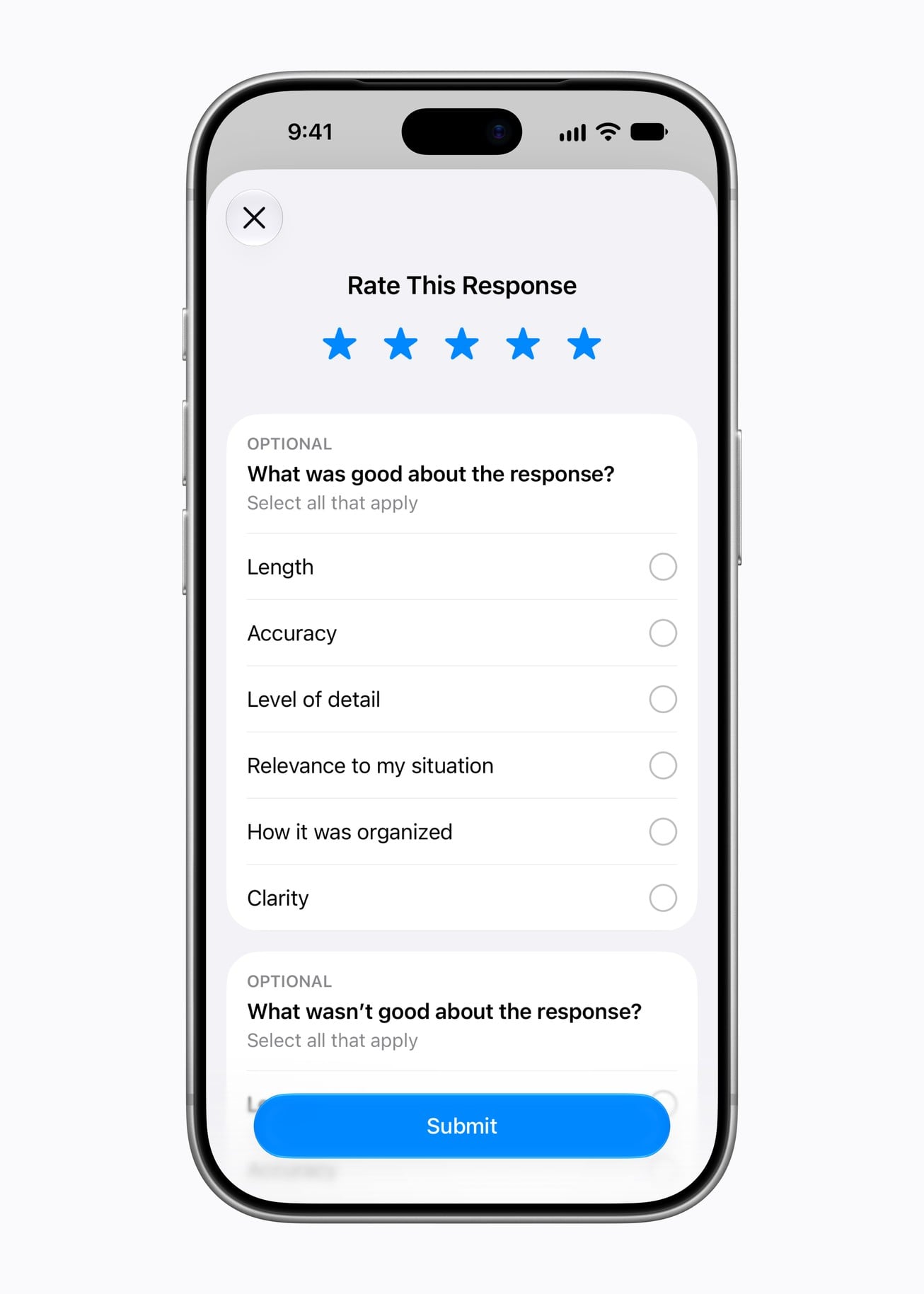 The study app asks participants to rate each response, in an image Apple released with its study announcement.
If people want to, they can share HealthKit data, including resting heart rate, lab results, sleep, and activity. Apple wants to see whether adding personal information to answers makes them more relevant and easier to understand.
The company said that consumer health tools made with LLMs don’t always give a full picture or make things clear. This is why Apple wants to look into the way health information is shown, the company said. The study also checks if the app helps people get ready for their own doctor visits.
Robert M. Wachter, M.D., chair of the Department of Medicine at UCSF, said, “Patients and clinicians are both turning to AI, but the tools they use are being built and tested in separate worlds.”
“Connecting these tools, and rigorously studying what works, is how we’ll get there,” Wachter said.
Data from up to 200,000 users stays out of model training
Apple will let up to 200,000 people in the US sign up. No one younger than 21 years old can enter. Entrants must have an iPhone 15 Pro or newer with Apple Intelligence and iOS 26 or later.
The study data will not be used to train AI models. Apple says that queries are made anonymous before they are sent to a safe third-party cloud provider. It added that after 24 hours, OpenEvidence deletes these questions and answers.
Participants can opt to share their HealthKit metrics or survey responses. The app points out some questions of concern and refers users to a provider or other related resources.
Apple says the app is not meant to diagnose or treat any illness and doesn’t replace medical advice from medical professionals.
A lot of medical traffic already goes through consumer AI chatbots. OpenAI said earlier this year that users ask more than 300 million health-related questions every week. OpenAI extended ChatGPT Health to all US adults in July, a day after a Florida pastor filed a lawsuit against the company, according to Cryptopolitan. He claimed the chatbot told him not to see a doctor, advice he said almost killed him.
Apple released a new Health Age score in September that was linked to a $119 blood test from Quest Diagnostics.
The smartest crypto minds already read our newsletter. Want in? Join them.