
Research
What Is GRVT? Inside the Self-Custodial Exchange Ahead of the $GRVT Listing
A licensed, self-custodial derivatives exchange is about to launch its token. Here's what GRVT is, who's backing it, and how to get in ahead of the $GRVT listing.
Key Takeaways
- GRVT is a self-custodial hybrid derivatives exchange founded in 2022, matching orders off-chain while settling trades on-chain on a ZKsync Validium Layer 2.
- GRVT has raised ~$34M across five funding rounds, led by a $19M Series A co-led by 500 Global, Further Ventures, EigenCloud, and ZKsync.
- $GRVT has a fixed 1 billion supply with no inflation, and the community and airdrop allocation was raised to 28%.
- GRVT lists 169+ perpetual markets across crypto and real-world assets — gold, oil, and tokenized equities — with institutional RWA yield wired in via Centrifuge and Plume.
- With Season 2 closed on June 30, 2026, GRVT has set July 21, 2026 as $GRVT's go-live/listing date, with the token debuting on GRVT's own spot market first.
What Is GRVT?
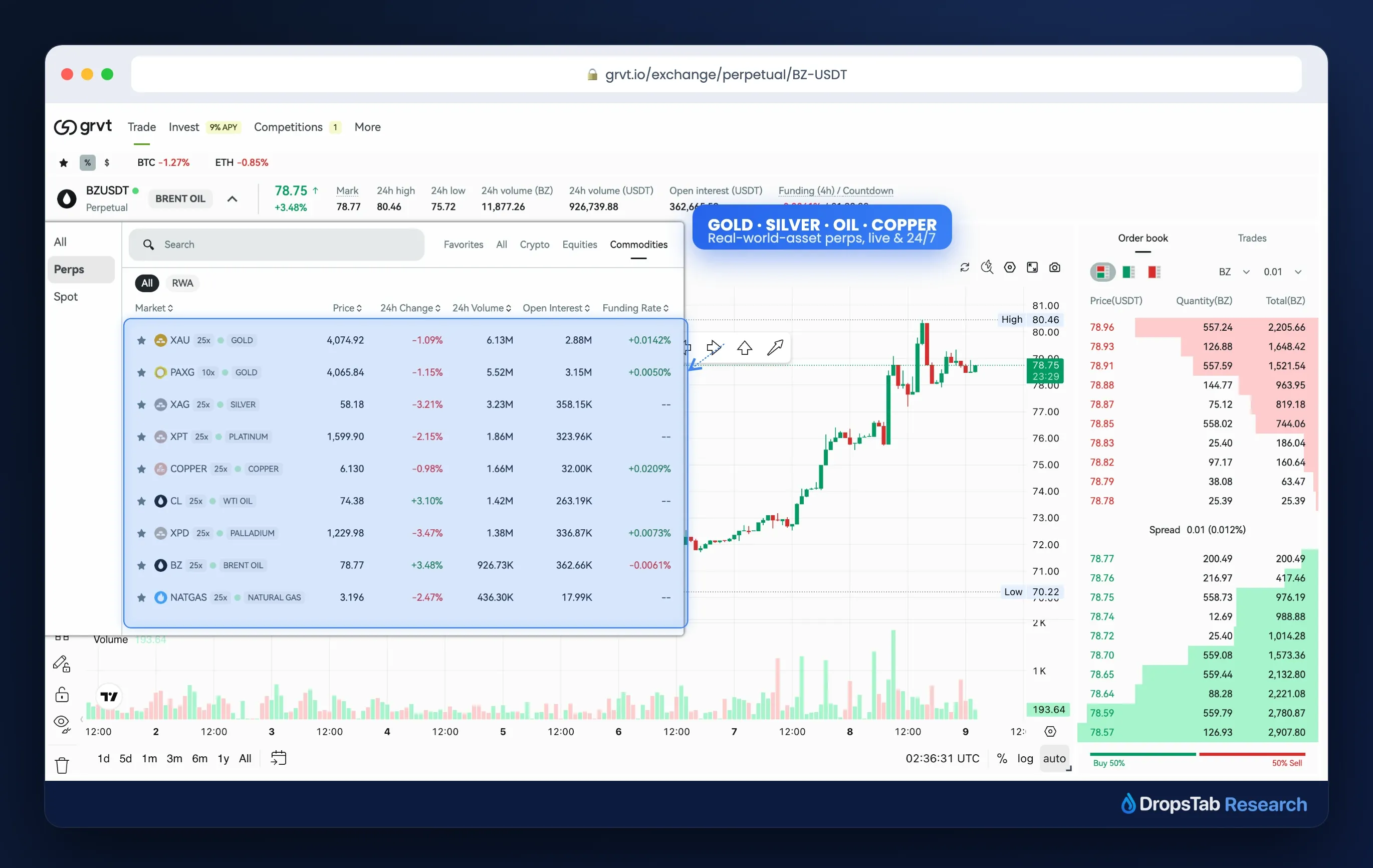
GRVT is a self-custodial derivatives exchange founded in 2022 that combines off-chain order matching with on-chain settlement on a ZKsync Validium Layer 2. GRVT lists roughly 169 perpetual pairs spanning crypto and real-world assets, including gold, oil, and tokenized equities, and markets itself as a regulated exchange.
The pitch is simple to state and harder to deliver: give traders the speed of a centralized order book without asking them to hand over custody of their funds. GRVT keeps assets in user-controlled accounts and settles positions on-chain, while the matching engine runs off-chain for latency. The exchange already lists more than 160 perpetual markets across crypto and real-world assets, and the roster keeps growing.
The differentiator against crypto-only perp venues is asset breadth. Alongside standard crypto perps, GRVT offers exposure to gold (XAU), oil (WTI), and tokenized equities such as Tesla. GRVT reports its engine can process up to 600,000 transactions per second, putting centralized-exchange-grade speed behind a self-custodial model.
How Does GRVT Work? The Self-Custodial (Hybrid) Model
GRVT runs a hybrid model that matches orders off-chain for speed while settling trades on-chain so users keep custody. GRVT builds on a ZKsync Validium Layer 2, which validates state with zero-knowledge proofs verified on Ethereum but keeps transaction data off the mainnet. Data availability is handled by EigenDA and a Validium committee.
The architecture is the core of the story. A ZKsync Validium — per L2Beat and Messari classifications as of July 2026 — inherits Ethereum-level security through ZK proofs while keeping transaction data off-chain for privacy and cost. For data availability, GRVT uses EigenDA (part of EigenCloud) alongside a Validium data-availability committee — keeping costs low and throughput high while every batch of transactions stays verifiable on Ethereum. The result is centralized-exchange performance with the privacy and self-custody of an on-chain venue.
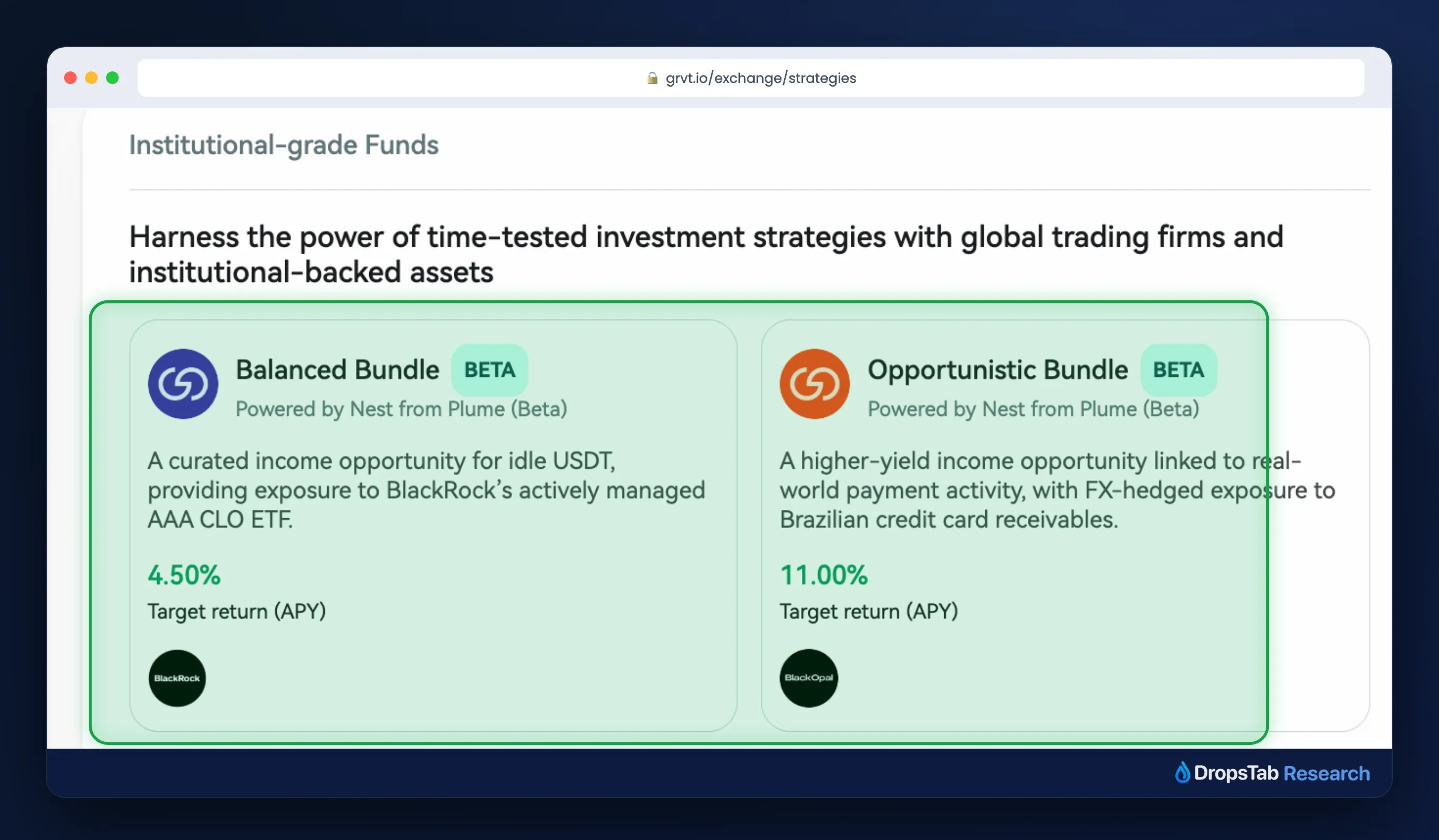
On the RWA side, GRVT has wired institutional yield in through partnerships with Centrifuge (a mid-May 2026 integration of the Janus Henderson Anemoy US Treasury fund, from $1) and Plume (late May 2026), packaged into three self-custodial yield products — base, balanced, and opportunistic — that include exposure linked to the iShares AAA CLO Active ETF (~$2.2B AUM). It's a concrete step toward the "trade everything" positioning, not just a crypto perp venue with a gold ticker bolted on.
Who Is Behind GRVT? Backers and Funding
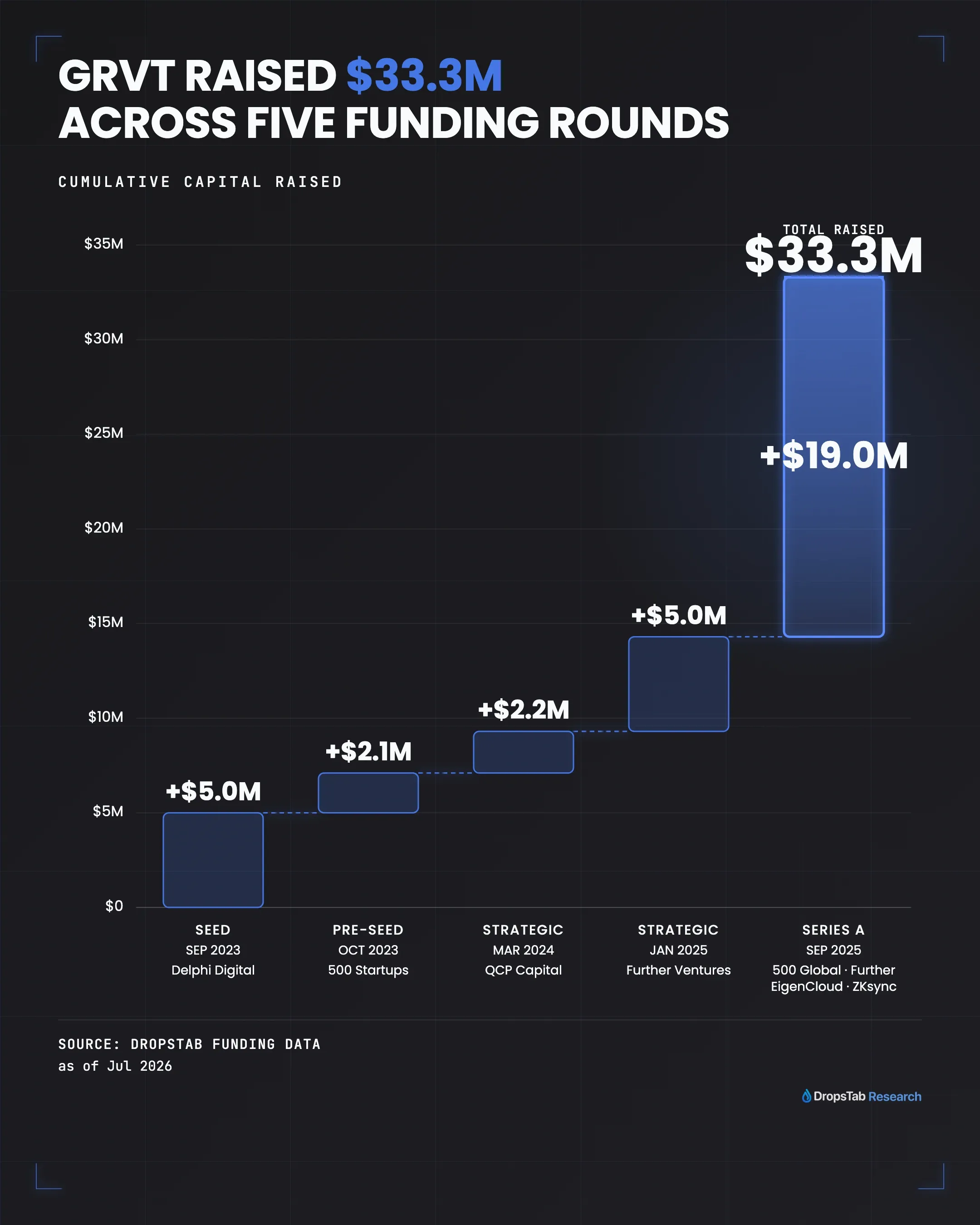
GRVT has raised around $34 million across five funding rounds since 2023, with the full round-by-round history tracked on DropsTab. GRVT's $19 million Series A in September 2025 was co-led by 500 Global, Further Ventures, EigenCloud, and ZKsync, with earlier rounds backed by Delphi Digital, CMS Holdings, QCP Capital, Matrix Partners, and Matter Labs.
The backer list is the strongest signal GRVT has — and it's worth reading in full rather than trusting a single headline number. The presence of ZKsync (Matter Labs) and EigenCloud isn't just capital; both are infrastructure partners GRVT's stack is built on, which aligns their incentives directly with GRVT's success.
The founding team reads similarly institutional. CEO Hong Yea spent close to a decade trading at Goldman Sachs and Credit Suisse before starting GRVT in 2022, and CTO Aaron Ong was a tech lead on data-privacy frameworks at Meta. GRVT openly frames its ambition as building "the Goldman Sachs of on-chain finance," and the team's TradFi-and-Big-Tech pedigree backs up that pitch.
| Round | Date | Raised | Lead / Notable Investors |
|---|---|---|---|
| Series A | Sep 2025 | $19.0M | 500 Global, Further Ventures, EigenCloud, ZKsync (co-leads) |
| Strategic | Jan 2025 | $5.0M | Further Ventures |
| Strategic | Mar 2024 | $2.2M | QCP Capital, Pulsar Trading, Selini Capital |
| Pre-seed | Oct 2023 | $2.1M | 500 Startups, Folius Ventures |
| Seed | Sep 2023 | $5.0M | Delphi Digital, CMS Holdings, Matrix Partners, Hack VC, ABCDE Capital, SIG, Matter Labs |
| Total | — | ~$34M | Across five rounds since 2023 |
Round history: DropsTab funding data, as of July 2026. Series A also reported by CoinDesk, Sep 19, 2025.
When GRVT announced its Series A, the team put it plainly: the round "brings our total funding to $34M." That's a well-capitalized backer set, with recognizable trading-desk and infra names — QCP Capital, Selini, SIG — on the cap table. You can track $GRVT on DropsTab alongside these rounds.
What Is the $GRVT Token? Supply, Utility, and the July 21 Listing
$GRVT is the fixed-supply native token of the GRVT exchange, capped at 1 billion units with no inflation. GRVT allocates 28% to community and airdrop rewards and earmarks roughly 33.1% for future emissions within the fixed cap. Its Season 2 campaign closed on June 30, 2026, and GRVT has set July 21, 2026 as $GRVT's go-live date.
Start with what's confirmed: a hard cap of 1,000,000,000 $GRVT with no inflationary issuance. GRVT raised the community and airdrop allocation to 28% (from a planned 22%), which is a genuinely community-favorable move. Roughly 33.1% of supply is earmarked for future emissions within that fixed cap, and the remaining share covers team, investors and strategic partners, and the ecosystem.
Season 2 wrapped up on June 30, 2026, and GRVT is now in the run-up to launch. The headline date is set: GRVT has announced July 21, 2026 as $GRVT's go-live. In GRVT's own words: "The date is set and it's official. $GRVT goes LIVE July 21." At launch, the token lists on GRVT's own spot market first, with tier-1 exchange listings to follow.
How Does the $GRVT Airdrop Work?
GRVT distributes $GRVT airdrop rewards through its trading seasons, with the Season 2 allocation raised from 12% to 18% of total supply. Claiming the $GRVT airdrop requires KYC verification, though general trading on GRVT has been optional and KYC-light since August 2025.
When GRVT moved the TGE, it also sweetened the airdrop, "increasing the Season 2 reward allocation from 12% to 18% of the total supply." That's a meaningful boost for Season 2 participants heading into the listing — more of the supply is going to the community. Claiming the airdrop requires KYC verification, while general trading on GRVT has stayed KYC-light since August 2025.
GRVT vs Hyperliquid vs dYdX
GRVT, Hyperliquid, and dYdX are all derivatives exchanges offering crypto and real-world-asset perpetuals, but they differ in design and positioning. GRVT runs a self-custodial ZKsync Validium hybrid with off-chain matching; Hyperliquid runs its own on-chain-orderbook L1; and dYdX v4 is a Cosmos SDK appchain. GRVT's edge is wrapping it all in a regulated, self-custodial package.
The comparison highlights where GRVT stands apart. Real-world-asset perps are a fast-growing arena and all three trade them, but GRVT is the one pairing that breadth with a self-custodial, regulated (Class M) wrapper — and it's the only one of the three whose token listing is still ahead, making the $GRVT launch an event to get in front of rather than one you've missed.
| Feature | GRVT | Hyperliquid | dYdX |
|---|---|---|---|
| Architecture | ZKsync Validium L2 (off-chain match + on-chain settle) | Own L1 (HyperBFT), fully on-chain orderbook | Cosmos SDK appchain (v4) |
| Markets | Crypto + RWA perps (gold, oil, equities) | Crypto + RWA perps (equities, FX, commodities) | Crypto + select RWA perps |
| Regulation | Class M digital-asset license | — | — |
| Token status | $GRVT — listing 2026 | HYPE — live | DYDX — live |
GRVT's core edge: a regulated, self-custodial wrapper around crypto-and-RWA perpetual trading.
GRVT's hybrid design pairs centralized-exchange-grade speed with self-custody, and wraps crypto-and-RWA trading in a regulated, keep-your-own-keys package. For traders who want that combination — plus a fresh token event to trade into — GRVT is the one to watch.
Is GRVT Safe? Self-Custody and Regulation
GRVT is built around self-custody: users keep control of their own funds at all times, which removes the exchange-insolvency risk that has hurt centralized venues. Trades settle on-chain with zero-knowledge proofs verified on Ethereum, and GRVT holds a Class M digital-asset license — so safety rests on both cryptography and a formal regulatory framework.
Self-custody is the headline safety feature. Unlike a traditional exchange that holds your assets for you, GRVT keeps funds in user-controlled accounts and settles positions on-chain, so you never hand your balance to the platform. On the compliance side, GRVT secured a Class M digital-asset license in December 2024, making it one of the first on-chain derivatives venues to operate inside a formal regulatory framework — GRVT describes itself as the world's first regulated DEX.
Put together, the model aims to combine what traders like about centralized exchanges — speed, deep product range, a compliant wrapper — with what they like about DeFi: keeping their own keys.
Want to be positioned before July 21? GRVT's Telegram Mini App closed beta is the way in: apply for the GRVT Telegram Mini App closed beta to explore the product and build your Season 2 standing ahead of the TGE.